Tencent Launches Hy4 Flash, a Lower-Cost Multimodal AI Model With 1M-Token Context
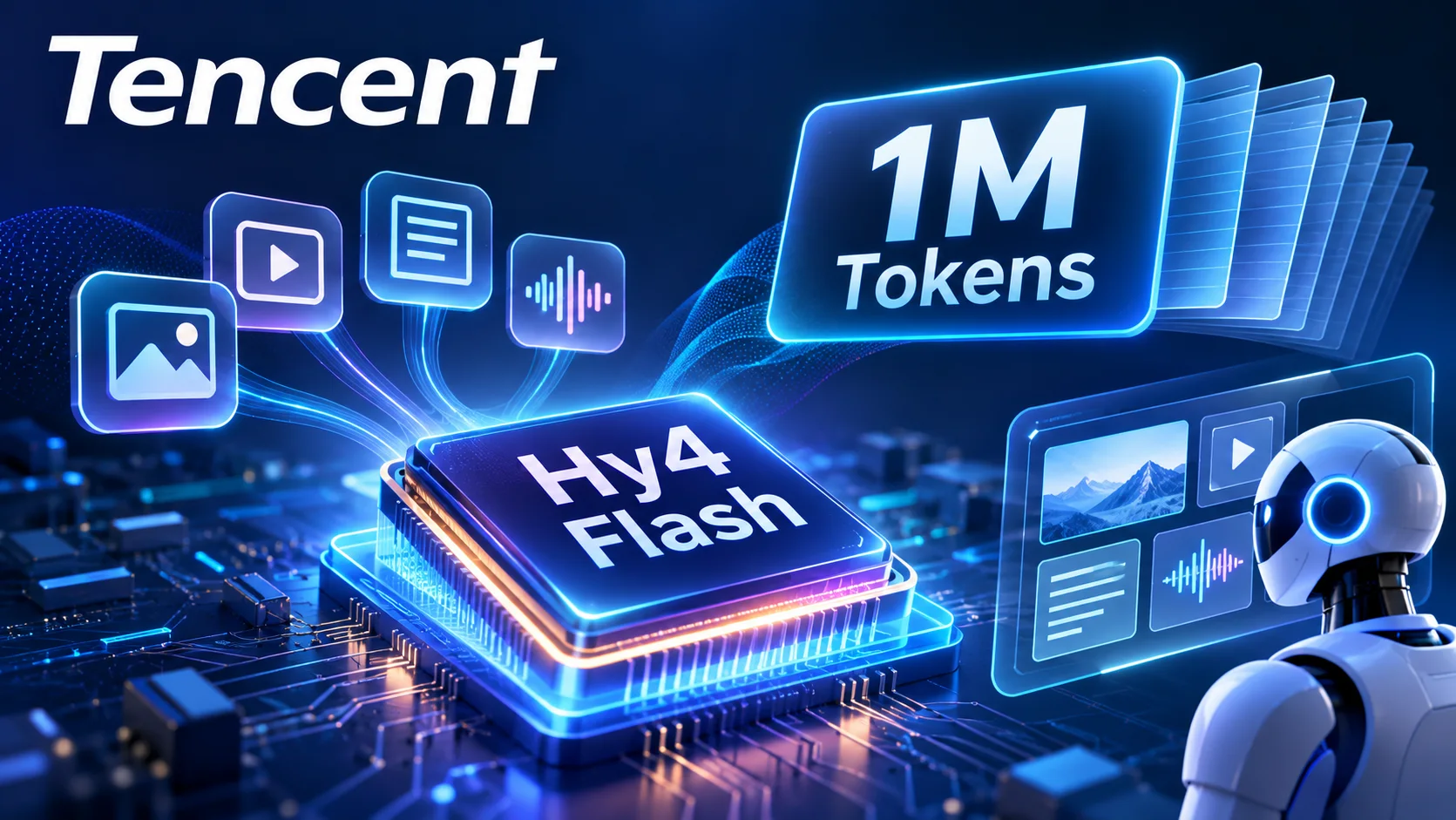
Tencent has introduced Tencent Hy4 Flash, a lower-cost multimodal artificial intelligence model designed for everyday productivity and business workflows. The model has 224 billion total parameters but activates only 12 billion per token. It also supports multimodal inputs and a context window of up to one million tokens.
Announced on November 16, the model is the latest addition to Tencent's Hy family. The company is positioning it as a more affordable option for tasks such as research, document processing, presentation creation and computer use. Its international API pricing starts at approximately $0.07 per million input tokens, making cost efficiency a central part of the release.
Tencent Hy4 Flash Uses a Smaller Active Parameter Count
Although the model contains 224 billion parameters, only 12 billion are activated for each token. This design allows Tencent to maintain a large overall model while limiting the portion of its network involved in processing each token.
The architecture incorporates hybrid attention, LatentMoE and Engram components. The 224-billion total also includes 64 billion Engram parameters. Tencent says these engineering choices help reduce computing and memory requirements while maintaining useful performance across different tasks.
The one-million-token context window is another important feature. It allows the model to process large amounts of information within a single context, which can help with lengthy documents, research material and multi-stage work.
Lower API Pricing Targets Everyday AI Work
Tencent lists Hy4 Flash at approximately $0.070 per million input tokens and $0.281 per million output tokens. Cached input is priced at $0.003 per million tokens.
These are separate charges for processing new input, generating responses and reusing cached information. The distinction matters for businesses estimating the cost of running AI applications at scale, particularly when workflows involve repeated documents or large volumes of requests.
Tencent is also offering promotional access. Through November 30, users can access the model free through WorkBuddy, while Tencent Cloud TokenHub offers a 50% reduction from standard API pricing during the promotional period.
Model Targets Research, Documents and Computer Use
Tencent recommends Hy4 Flash for everyday tasks, including deep research, document editing, PowerPoint creation, spreadsheet repair and computer-use workflows.
The company reports that the model performs slightly better than its larger Hy4 Preview in overall effectiveness on its internal WorkIndex evaluation, while costing substantially less per task. Tencent also conducted a blind evaluation involving 85 WorkBuddy users across 259 tasks in 27 categories. It reported user satisfaction close to Claude Haiku 5.5.
These results come from Tencent's own testing and should not be treated as independent confirmation of performance across all applications. The company has also recommended its more capable Hy4 model for demanding tasks such as long-running software engineering projects.
Tencent Expands Its AI Model Distribution
Hy4 Flash is available through Tencent Cloud TokenHub and several of the company's products, including WorkBuddy, Yuanbao, WeCom, QQ, ima and Marvis. Tencent has also indicated that OpenRouter integration is planned.
The company says it intends to open-source the model and release further iterations. However, the announcement describes this as a future plan rather than confirming that the model weights are already publicly available.
The launch adds another option to a competitive market where AI providers are trying to reduce the cost of long-context and multimodal systems. For businesses, the appeal will depend on whether the lower pricing translates into reliable results across real workloads.
Tencent's strategy is to make advanced AI more practical for routine tasks, while reserving its larger model for more demanding work. Whether Hy4 Flash can maintain that balance will become clearer as developers and businesses test it independently.