Unitree Humanoid Robots Priced at ₹20–60 Lakh Draw Crowds at Bengaluru Tech Summit
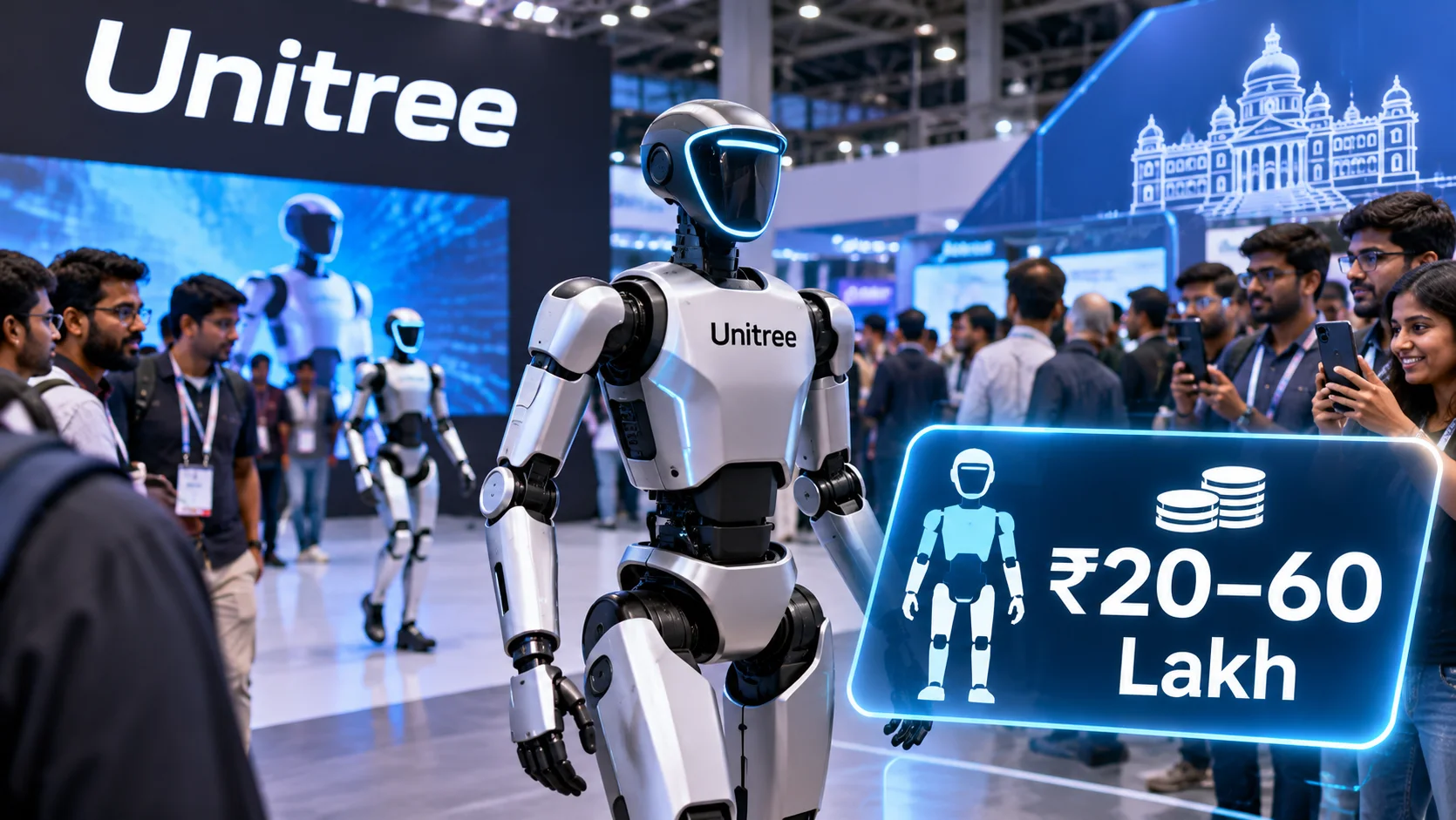
Unitree humanoid robots attracted attention at the Bengaluru Tech Summit 2026, where the Chinese robotics manufacturer displayed its G1 humanoid alongside four-legged robotic machines. The showcase highlighted growing interest in advanced robotics in India, as businesses, research institutions and visitors explored potential applications beyond conventional industrial automation.
According to a report by The Times of India published on November 17, the G1 is priced between ₹20 lakh and ₹60 lakh in India, depending on its configuration and intended application. A Unitree representative also told the publication that around 50 humanoid units had been sold in the country, including to large companies. The buyers were not identified.
Unitree Humanoid Robots Showcase the G1's Capabilities
The G1 is designed primarily as a platform for research, development and robotics applications. It can walk, navigate environments and manipulate objects, making it useful for testing technologies that could eventually support more complex automated tasks.
The representative told The Times of India that the robot can handle objects weighing approximately 2–3 kg. Unitree's official specifications distinguish between the standard G1 and the G1 EDU, which supports additional configurations. The company's product information lists 23 degrees of freedom for the standard model, while the EDU version can be configured with up to 43.
The G1's capabilities make it relevant to universities, robotics developers and organisations experimenting with embodied AI. However, a research platform capable of performing demonstrations is not necessarily ready to replace human workers across demanding industrial environments.
Robotic Dogs and Specialised Machines Expand the Display
Unitree also presented its quadruped robotic dogs, machines that use four legs to move across different surfaces. These platforms are used in research and education, including experiments involving mobility, sensing and autonomous navigation.
The company's wider product range includes machines intended for specialised applications. The Bengaluru showcase featured references to firefighting and logistics, including the G1-D humanoid designed for warehousing and logistics-related work.
These different designs reflect the expanding robotics market. Humanoids are being developed for tasks that require human-like movement and object handling, while quadruped robots can be useful in environments where wheels are less practical.
India's Humanoid Robotics Market Remains at an Early Stage
The reported sale of around 50 Unitree humanoids in India offers an indication of early customer interest, but it should not be interpreted as evidence of widespread commercial adoption. The company representative did not disclose the buyers or provide a breakdown of how many robots are being used for research, demonstrations or operational work.
Pricing is another important consideration. The ₹20–60 lakh range reported in India varies by configuration and application. Unitree's official global G1 product page lists a starting price of US$13,500 before taxes and shipping, but that base figure should not be directly compared with the reported Indian range without accounting for model variants, import costs and local pricing.
For now, research institutions, technology companies and specialist users appear to be important early customers for advanced humanoids. Their experience will help establish whether these machines can deliver reliable performance outside controlled demonstrations.
Unitree's appearance at the Bengaluru Tech Summit reflects the growing visibility of physical AI in India. The next challenge for the industry will be turning public interest and pilot projects into practical, repeatable deployments.