Vega-C Set to Launch FLEX and Sentinel-3C Earth-Observation Satellites
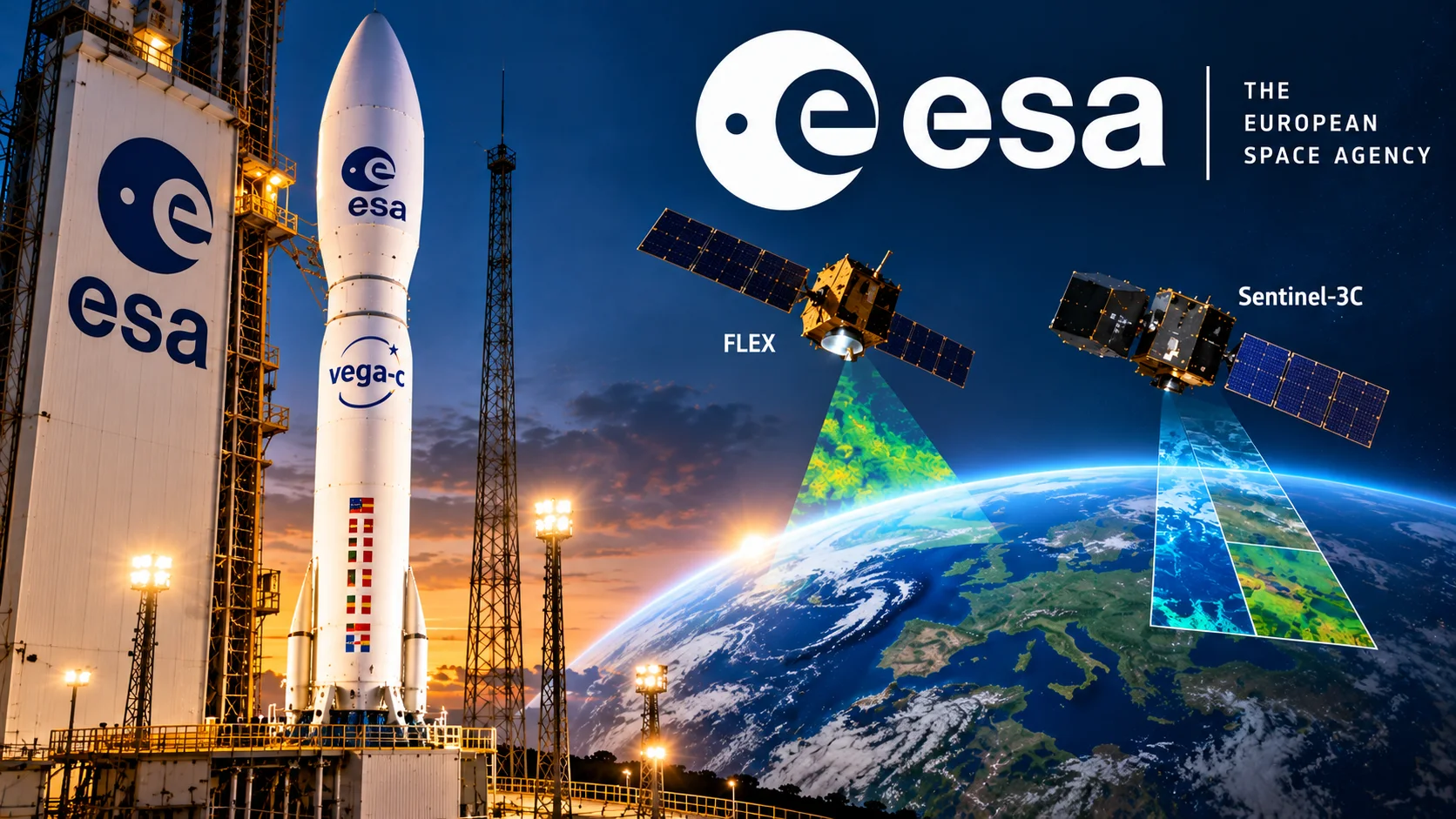
Europe is preparing to launch two Earth-observation satellites aboard a Vega-C rocket as the European Space Agency moves forward with a mission designed to expand monitoring of Earth’s environment. The rocket is scheduled to lift off from Europe’s Spaceport in French Guiana at 22:21 local time on September 14, carrying ESA’s Fluorescence Explorer (FLEX) and the Copernicus Sentinel-3C satellite.
The mission, designated VV30, is scheduled for 01:21 UTC on September 15. Sentinel-3C will join the existing Sentinel-3A and Sentinel-3B spacecraft, while FLEX will study the faint fluorescence emitted by vegetation during photosynthesis.
FLEX Will Track Plant Photosynthesis
FLEX is designed to measure solar-induced fluorescence from vegetation, a faint signal produced by plants during photosynthesis. Scientists can use these measurements to study how efficiently plants absorb carbon dioxide and respond to environmental conditions.
The satellite will provide data that can help researchers examine plant health, productivity and the effects of climate-related changes on vegetation. FLEX is part of ESA’s Earth Explorer programme and represents more than two decades of scientific and technical development.
Sentinel-3C Extends Copernicus Monitoring
Sentinel-3C will become the third satellite in the Sentinel-3 series and will continue collecting measurements used to monitor oceans, land, ice and the atmosphere. Its data will support environmental monitoring and services across Europe and beyond.
The satellite is designed to operate in a Sun-synchronous orbit at roughly 820 kilometres above Earth. It will work alongside Sentinel-3A and Sentinel-3B, extending the continuity of measurements from the Copernicus programme.
Vega-C Carries Two Missions Together
The two satellites have been integrated under the fairing of the Vega-C launcher at Europe’s Spaceport in French Guiana. The rocket is about 35 metres tall and weighs roughly 210 tonnes when positioned on the launch pad.
Launching the spacecraft together allows a single Vega-C mission to place both Earth-observation payloads into orbit. The mission also comes as Europe works to increase the availability and cadence of its own launch vehicles to support growing demand for satellite deployments.
Mission Adds to Europe’s Earth-Observation Network
The VV30 mission is important beyond the launch itself because both spacecraft are intended to provide long-term environmental data. FLEX will add a new type of measurement focused on plant activity, while Sentinel-3C will strengthen an existing monitoring network covering major components of the Earth system.
If the launch proceeds as scheduled, the mission will give European researchers another set of tools for studying changes across land, vegetation, oceans and the atmosphere. The data will contribute to scientific research as well as environmental monitoring and climate-related services.