Vega-C Successfully Launches Sentinel-3C and FLEX Earth-Observation Satellites
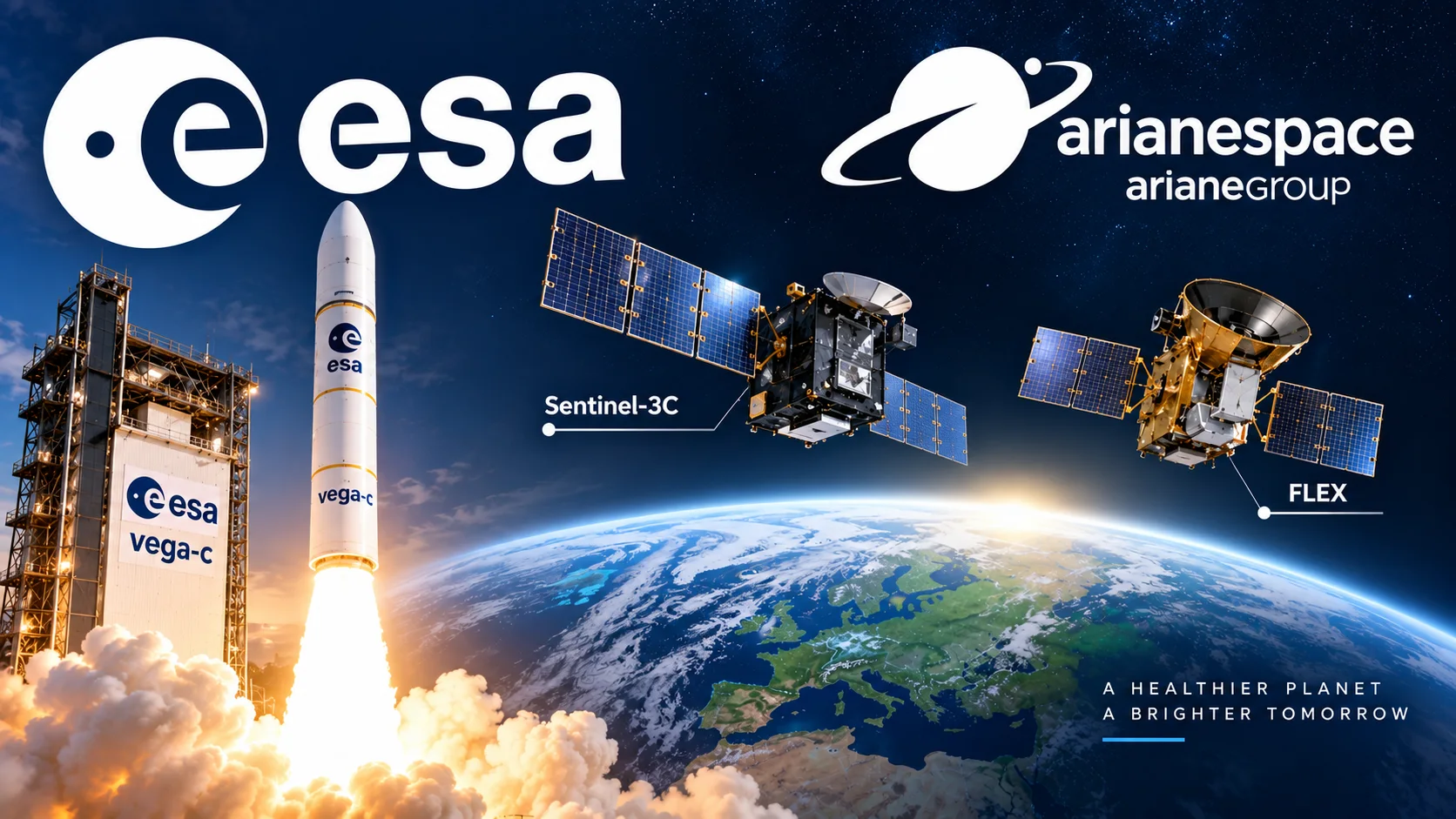
A Vega-C rocket successfully launched the Copernicus Sentinel-3C and ESA’s FLEX satellites from Europe’s Spaceport in French Guiana at 01:21 UTC on September 15. Both spacecraft were deployed into their planned orbits, marking another important mission for Europe’s Earth-observation programme.
The mission brings together two satellites with different but complementary objectives. Sentinel-3C will collect data on oceans, land and atmospheric conditions, while FLEX will focus on vegetation by measuring the fluorescent light emitted by plants during photosynthesis.
Sentinel-3C to Monitor Earth’s Changing Environment
Sentinel-3C is part of the European Union’s Copernicus programme and will provide measurements of the planet’s oceans and land surfaces. Its observations will support monitoring of sea-surface conditions, vegetation, land cover and atmospheric changes.
The satellite will work alongside other Sentinel-3 spacecraft to provide continuous environmental data. These observations are used for applications ranging from climate monitoring and ocean forecasting to agriculture and disaster response.
FLEX Will Study Plant Photosynthesis
ESA’s FLEX (FLuorescence EXplorer) satellite has a more specialised mission. It will measure the faint fluorescence emitted by vegetation during photosynthesis, giving scientists a new way to understand how efficiently plants absorb carbon dioxide and convert sunlight into energy.
The data will help researchers study global vegetation health and improve understanding of carbon and water cycles. FLEX is designed to work with the Copernicus Sentinel-3 mission, combining its fluorescence measurements with other environmental observations.
Vega-C Expands Europe’s Launch Capability
The successful mission also adds to the operational record of Vega-C, Europe’s next-generation small-to-medium-lift rocket. Its ability to launch multiple Earth-observation spacecraft in a single mission provides European institutions with additional flexibility for deploying scientific and environmental satellites.
With Sentinel-3C and FLEX now beginning their commissioning phases, scientists will gain new sources of data for studying changes across Earth’s surface and atmosphere. The mission highlights the growing role of satellite observations in understanding climate, ecosystems and environmental change.